Introduction to the Prompt Hierarchy
In the field of Applied Behavior Analysis (ABA), teaching new skills is a systematic and data-driven process. One of the most fundamental and effective tools in the ABA toolkit is the prompt hierarchy. A prompt is a cue or assistance given to a learner to help them perform a skill correctly. The prompt hierarchy is a systematic arrangement of these prompts from most to least intrusive, providing a framework for teaching new skills and then gradually fading support to promote independence. This article provides a comprehensive guide to the ABA prompt hierarchy, exploring the different types of prompts, the strategies for using them, and their critical role in effective ABA therapy. Understanding the prompt hierarchy is essential for any ABA professional, from the Registered Behavior Technician (RBT) to the Board Certified Behavior Analyst (BCBA), as it is a cornerstone of effective and ethical practice.
What is Prompting in ABA?
Prompting is a key component of the three-term contingency (Antecedent-Behavior-Consequence) in ABA. A prompt is an antecedent stimulus that is added to the environment to increase the likelihood that the learner will emit the correct behavior. The goal of prompting is not to do the skill for the learner, but rather to guide them to success. This success is then reinforced, which strengthens the association between the instruction and the correct response. Prompts are used to teach a wide range of skills, from basic life skills like washing hands to complex academic and social skills.
The Levels of the Prompt Hierarchy
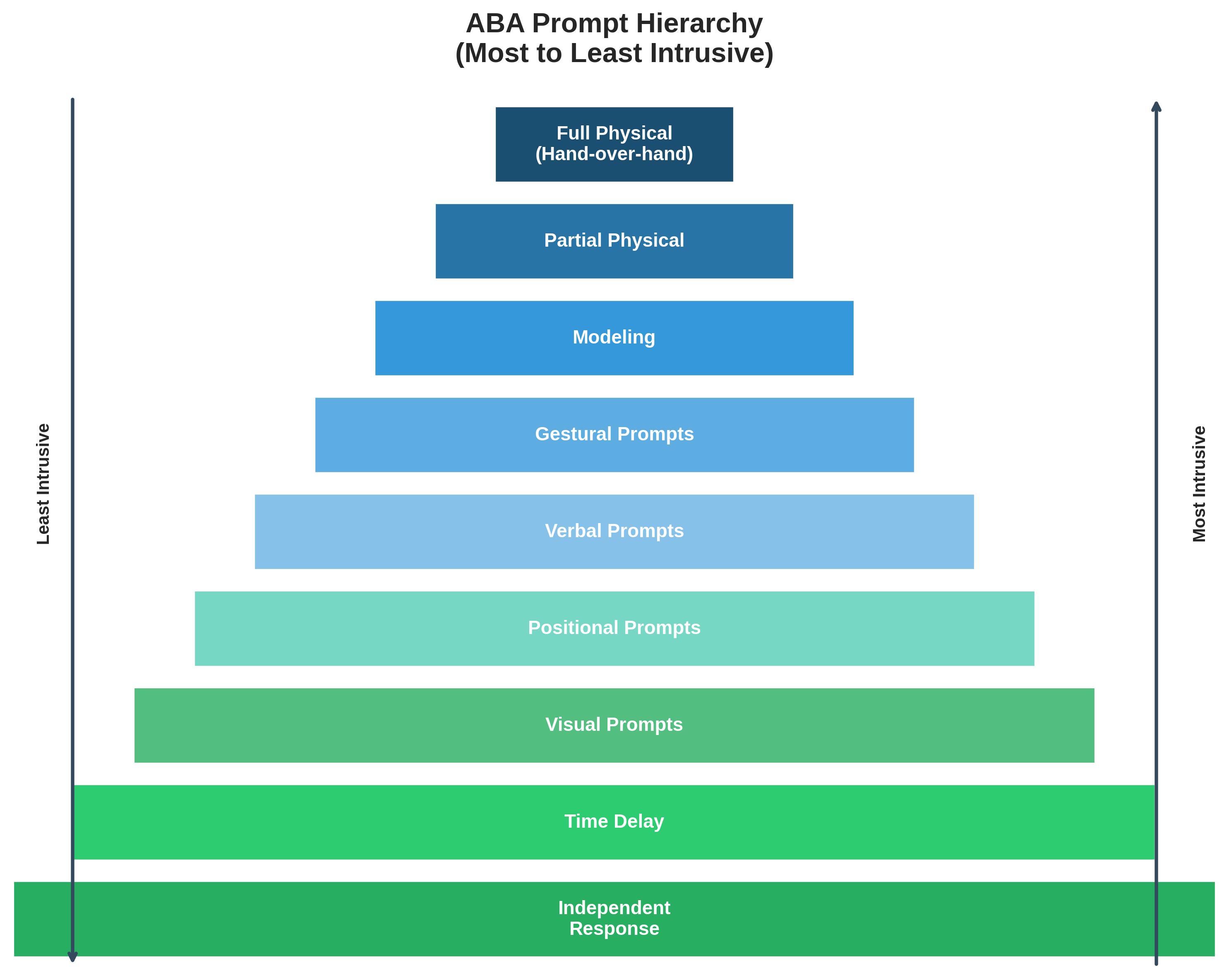
The prompt hierarchy is often visualized as a pyramid or a continuum, with the most intrusive prompts at the bottom and the least intrusive at the top. The goal is always to use the least intrusive prompt necessary to ensure the learner's success and to fade to independence as quickly as possible. The following are the main levels of the prompt hierarchy, from most to least intrusive:
1. Full Physical Prompt (Hand-over-Hand)
This is the most intrusive type of prompt. It involves the therapist physically guiding the learner through the entire motor action of the skill. For example, the therapist might place their hands over the learner's hands to guide them in brushing their teeth.
2. Partial Physical Prompt
This is a less intrusive physical prompt where the therapist provides minimal physical guidance, such as a light touch to the elbow or shoulder, to cue the learner to perform the skill.
3. Modeling Prompt
With a modeling prompt, the therapist demonstrates the desired behavior for the learner. For example, the therapist might show the learner how to clap their hands and then ask the learner to do it.
4. Gestural Prompt
This type of prompt involves the therapist using a gesture, such as pointing, nodding, or looking at the correct object, to cue the learner.
5. Verbal Prompt
Verbal prompts can range from a full verbal instruction to a partial verbal cue. A direct verbal prompt might be, "Pick up the blue block." An indirect verbal prompt might be, "What comes next?"
6. Visual Prompt
Visual prompts involve using a picture, a written word, or another visual cue to help the learner. Visual schedules, for example, are a common type of visual prompt used to help individuals with autism navigate their day.
7. Positional Prompt
This is a subtle prompt where the therapist places the correct item closer to the learner to make it more likely that they will choose it.
8. Time Delay
Time delay is a procedure where the therapist waits for a set amount of time after giving the instruction to allow the learner to respond independently before providing a prompt. This is one of the least intrusive prompting methods.
Prompting Strategies: Most-to-Least vs. Least-to-Most
There are two primary strategies for moving through the prompt hierarchy: most-to-least and least-to-most.
Most-to-Least (MTL) Prompting
This strategy, also known as errorless learning, involves starting with the most intrusive prompt that guarantees success (e.g., a full physical prompt) and then systematically fading to less intrusive prompts as the learner becomes more proficient. MTL is often used when teaching new skills to minimize errors and the frustration that can come with them.
Least-to-Most (LTM) Prompting
In this approach, the therapist starts by giving the learner the opportunity to respond independently. If the learner does not respond or responds incorrectly, the therapist provides the least intrusive prompt necessary to get the correct response. If that prompt is not effective, the therapist moves up the hierarchy to a more intrusive prompt. LTM is often used for skills that the learner has already demonstrated some ability to perform.
The Importance of Prompt Fading
The ultimate goal of prompting is to fade the prompts until the learner can perform the skill independently in response to the natural cues in the environment. This process of systematically reducing and removing prompts is called prompt fading. If prompts are not faded effectively, the learner can become "prompt dependent," meaning they will only perform the skill when the prompt is present. Effective prompt fading is a critical component of good ABA therapy and is essential for promoting generalization and maintenance of skills.
The Role of the RBT in Prompting
Registered Behavior Technicians (RBTs) are the primary implementers of the prompting and prompt fading procedures designed by their BCBA supervisor. It is the RBT's responsibility to:
- Understand the different types of prompts and the prompt hierarchy.
- Implement the prompting strategy (MTL or LTM) as specified in the treatment plan.
- Collect accurate data on the level of prompting required for the learner to be successful.
- Communicate with their supervisor about the learner's progress and any challenges with the prompting procedure.
Conclusion: A Foundation for Learning
The prompt hierarchy is a fundamental and powerful tool in Applied Behavior Analysis. It provides a structured and systematic framework for teaching new skills, from the most basic to the most complex. By understanding the different levels of prompts, the strategies for using them, and the critical importance of prompt fading, ABA professionals can effectively and ethically guide learners toward greater independence and a higher quality of life. For anyone in the ABA field, a thorough mastery of the prompt hierarchy is not just a best practice—it is the foundation of effective teaching.